

Imagine the perfect class.
The kids are listening, repeating, smiling. Their movements are clean, their attention is focused, you feel calm — everything is going according to plan.
Now let’s be honest.
Someone is crying. Someone is running around. Someone is lying on the floor and completely “not in the dance.”
And at some point a thought appears: “Am I doing something wrong?”
No.
This is exactly what working with little kids looks like.
The first truth they don’t write in textbooks:
a child doesn’t come to class to “perform correctly.”
They come to experience a state.
And if you try to impose order right away, you’ll end up fighting their nature.
But if you learn to read it — you start guiding the process.
Unexpected situations here aren’t exceptions. They’re the norm.
The music doesn’t start.
One child refuses to join.
Another has already invented a game and pulled half the group into it.
The plan? The plan was over by minute ten.
And this is where the real work of a teacher begins.
Not when everything is going well.
But when everything starts falling apart.
At some point, a very important realization comes:
children don’t listen to your words.
They respond to your state.
If there’s tension inside, the group becomes even more chaotic.
If you’re calm, even the most active kids begin to settle into it.
This isn’t magic. It’s awareness.
So your main superpower is not control.
It’s calm.
There’s another important thing connected to this:
you don’t manage children through restriction. You guide them through redirection.
- Not “don’t run,” but “let’s all run together.”
- Not “calm down,” but “now we turn into little cats and move quietly.”
It sounds like a small detail.
But it completely changes the dynamic of the class.
This is how it looks in practice:
A child sits down and refuses to move.
You can say, “stand up, we’re working.”
Or you can say, “today you show the move, we all follow you.”
And suddenly they’re involved.
Two kids start running and laughing.
You can stop them and try to calm them down.
Or you can say, “stop — now everyone are fast little bunnies.”
And chaos becomes an exercise.
Someone starts crying.
You can get lost.
Or you can quietly give them a role:
“you hold the ball — we can’t start without you.”
And the child comes back.
The key is this:
you’re not shutting behavior down. You’re redirecting it.
And here are simple things that actually work:
- if attention drops — change the pace
- if chaos grows — turn it into a game
- if a child disconnects — give them a role
- if something isn’t working — simplify, don’t complicate
Props are not entertainment. They’re tools.
A ball gives rhythm.
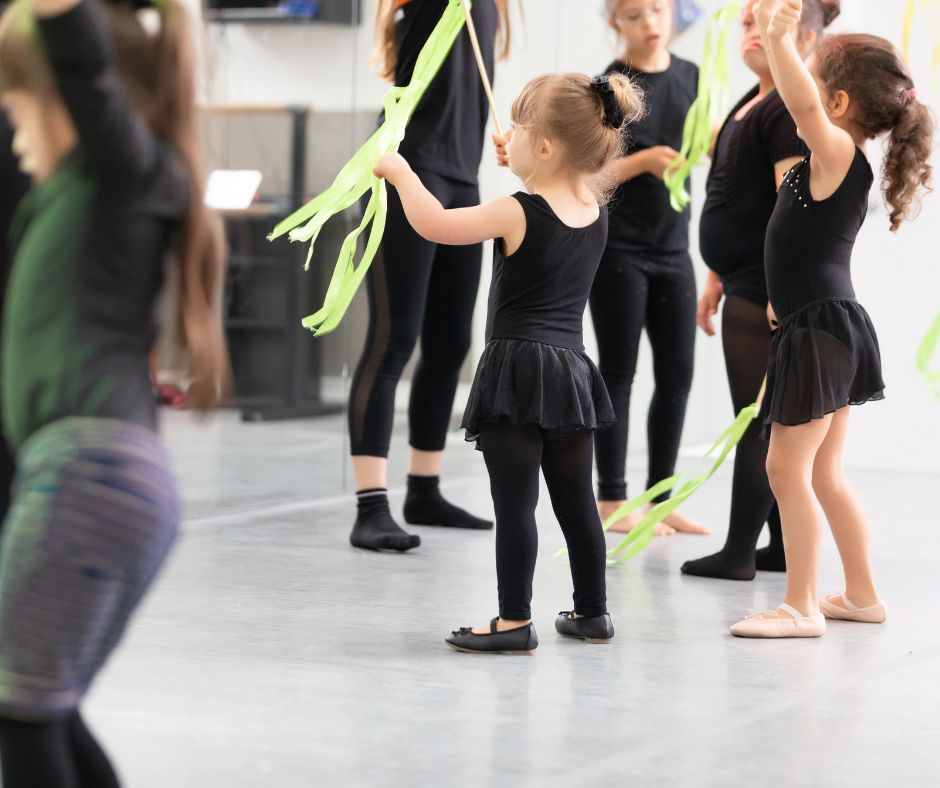
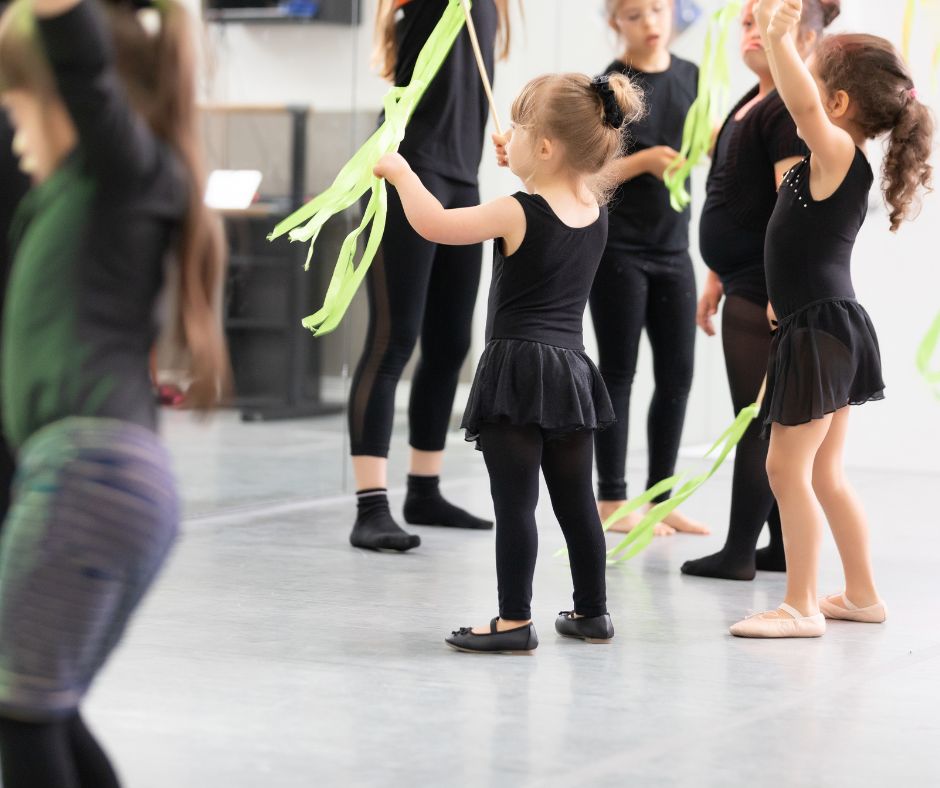
A ribbon gives line and range.
A soft toy gives character and emotion.
A child doesn’t understand “point your foot.”
But they understand “you’re a stretching cat.”
And suddenly the movement becomes right.
Here are a few exercises that save the moment when everything starts slipping:
Movement greeting
Everyone shows a move — everyone repeats.
The group engages within a minute.
Rhythmic self-massage
Clapping, tapping, simple words.
The body comes together, attention returns.
Rhythm echo
You set a rhythm — they repeat.
Simple, but very powerful.
Stop game
Move — stop — freeze.
Control appears very quickly.
Mini combination
2–3 moves, first slowly, then faster.
And kids feel: “I did it.”
And an important point that’s often missed:
less is better — but fully experienced.
Than more — but shallow.
And the ending that changes everything — a story.
Not just “we finished and that’s it.”
But “we are the wind,” “we are a wave,” “we are a team.”
And at that moment, children stop performing.
They start living the movement.
Working with little kids is not about a perfect class.
It’s about a living process where you constantly balance between structure and freedom.
And if at some point it feels like chaos —
you might be exactly where the real work begins.